Background
The global food environment has undergone rapid transformation over the past decades, characterized by increasing availability, affordability, and marketing of ultra-processed foods (UPFs). These products—often high in added sugars, salt, and unhealthy fats while low in essential nutrients—have become a growing component of diets worldwide, including in low- and middle-income countries.
Accumulating scientific evidence shows that high consumption of UPFs is associated with childhood overweight and obesity, micronutrient inadequacies, metabolic disorders, and early onset of non-communicable diseases (NCDs). Children and adolescents are particularly vulnerable to these dietary shifts due to aggressive marketing, widespread availability of highly processed foods in schools and communities, and broader food system transformations associated with the global nutrition transition.
Recent research suggests that diet quality should be assessed not only by nutrient composition but also by the degree of food processing. Consequently, global dietary recommendations increasingly emphasize “Eat Real Food” and minimally processed dietary patterns, encouraging diets centered on diverse plant foods, minimally processed staples, freshly prepared meals, and water as the default beverage.
The World Health Organization has emphasized the importance of regulatory interventions to promote healthier food environments. Policy instruments such as front-of-pack nutrition labelling, restrictions on marketing to children, and fiscal measures are increasingly recommended to reduce exposure to unhealthy food products. However, despite growing global commitment, significant policy and implementation gaps remain, particularly in protecting children and youth from unhealthy food environments.
Food labelling represents a critical entry point for public health action. Clear and interpretive labelling systems can empower consumers to make informed choices while incentivizing product reformulation.
International experience also demonstrates the effectiveness of integrated policy approaches. For example, Chile’s front-of-pack warning system, combined with marketing restrictions and school food policies, has been associated with measurable reductions in purchases of products high in nutrients of concern.
In Indonesia, the issuance of Government Regulation (PP) No. 28/2024 on Health provides an important policy opportunity. The regulation includes provisions on food and menu labelling, as well as strategies to reduce excessive consumption of salt, sugar, and fat.
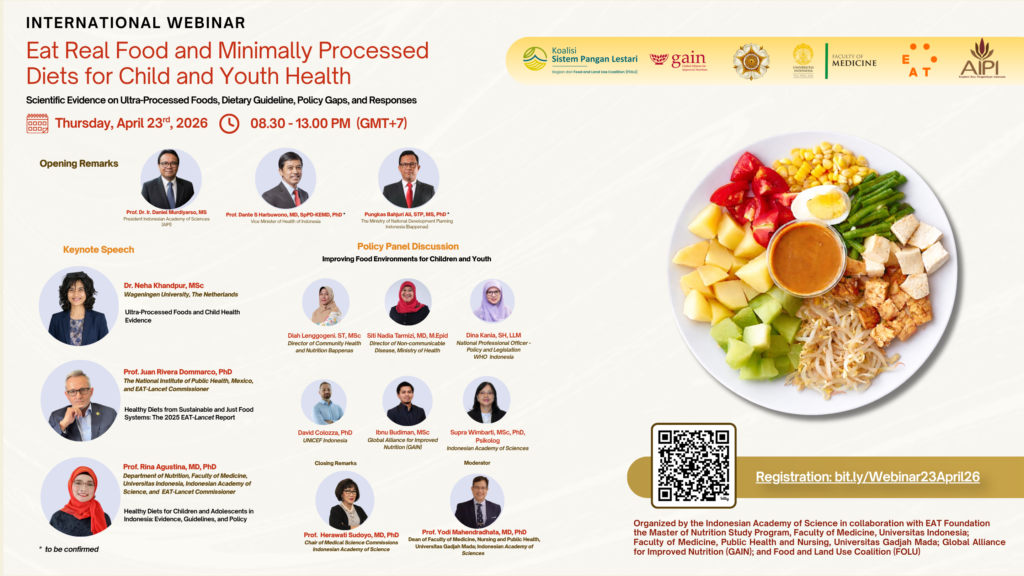
In response to these developments, the Indonesian Academy of Sciences (AIPI), through the Medical Sciences Commission (KIK), will organize an international webinar to facilitate dialogue among scientists, policymakers, and international organizations.
The event aims to connect scientific evidence, dietary guideline messaging, and policy actions that promote real and minimally processed foods while reducing exposure to ultra-processed foods.
This seminar will be held in collaboration with:
- EAT Foundation (Norway)
- Magister Study Program in Nutrition, Faculty of Medicine, Universitas Indonesia
- Faculty of Medicine Universitas Gadjah Mada – to be confirmed
- Indonesian Nutrition Initiative (IGI) – to be confirmed
- Food and Land Use Coalition (FOLU) Indonesia – to be confirmed
The event will bring together stakeholders from government, academia, international organizations, professional associations, and civil society.
Objectives
The webinar aims to:
- Present and critically discuss scientific evidence on the impact of ultra-processed food consumption on child and adolescent health, including pathways linking UPF intake with obesity, micronutrient deficiencies, poor diet quality, and increased metabolic risks.
- Examine global and national dietary guideline frameworks that promote minimally processed foods and healthier diets, including WHO guidance, Brazil’s Dietary Guidelines, Indonesia’s Isi Piringku, and the EAT-Lancet framework.
- Analyze Indonesia’s evolving food and nutrition policy landscape, particularly implementation opportunities under PP No. 28/2024, including its relevance for addressing unhealthy food environments and regulating products high in sugar, salt, and fat.
- Identify policy, regulatory, and knowledge gaps that hinder effective protection of children and youth from unhealthy food environments, including the marketing, availability, affordability, and social normalization of ultra-processed foods.
- Strengthen collaboration between academic institutions, policymakers, and international organizations to support evidence-based nutrition policy reform, particularly to promote healthier food environments and protect children and adolescents.
Agenda
| Sesi | Waktu | Deskripsi |
|---|---|---|
| Opening Session | 08:30 – 08:35 |
Master of Ceremony (MC) National Anthem: Indonesia Raya |
| Welcome and Opening Remarks | 08:35 – 08:55 |
Prof. Daniel Murdiyarso, Ph.D. (President Indonesian Academy of Sciences (AIPI))
Prof. dr. Dante S. Harbuwono, Sp.PD-KEMD, Ph.D. (Vice Minister of Health, Republic of Indonesia)
Pungkas Bahjuri Ali, STP., MS., Ph.D. (The Ministry of National Development Planning Indonesia (Bappenas)) |
| Child Health, Food Systems, and Policy Context | 08:55 – 09:00 |
Moderator: Prof. dr. Yodi Mahendradhata, M.Sc, Ph.D., FRSPH. (AIPI/Dean of Faculty of Medicine, Nursing and Public Health, UGM) |
| Keynote 1: Ultra-Processed Foods and Child Health Evidence | 09:00 – 09:30 |
Dr. Neha Khandpur, M.Sc. (Wageningen University, The Netherlands)
|
| Keynote 2: Healthy Diets and Food Systems; Environmental and justice aspects | 09:30 – 10:00 |
Prof. Juan Rivera Dommarco, Ph.D. (The National Institute of Public Health, Mexico, and the EAT-Lancet Commissioner) |
| Keynote 3: Indonesia’s Dietary Guidelines and Policy Context | 10:00 – 10:30 |
Prof. Rina Agustina, MD., Ph.D. (Department of Nutrition, Faculty of Medicine, Universitas Indonesia; Indonesian Academy of Science; the EAT-Lancet Commissioner) |
| Discussion and Q&A with Keynote Speakers | 10:25 – 10:45 |
Moderator |
| Policy Panel Discussion: Improving Food Environments for Children and Youth | 10:45 – 12:15 |
Moderator Prof. dr. Yodi Mahendradhata, M.Sc, Ph.D., FRSPH. (Indonesian Academy of Sciences (AIPI))
Speaker 1 Diah Lenggogeni, ST., M.Sc. (Director of Community Health and Nutrition (Bappenas))
Speaker 2 Dr. Siti Nadia Tarmizi M.Epid. (Director Non Communicable Disease)
Speaker 3 Dina Kania, SH., LLM. (World Health Organization Indonesia )
Speaker 4 Dr. David Colozza (UNICEF Indonesia)
Speaker 5 Ibnu Budiman, MSc (GAIN)
Speaker 6 Prof. Supra Wimbarti, M.Sc., PhD., Psikolog. (Member of Indonesia Academy of Science (AIPI)) |
| Open Discussion and Audience Q&A | 12:15 – 12:40 |
Moderator |
| Summary of Key Messages and Closing Remarks | 12:40 – 13:00 |
Prof. Herawati Sudoyo, MD., Ph.D. (Chair of Medical Science Commissions and Head of Organizing Committee) |














Organized by