Press Release
Rethinking How We Understand Disasters in the Indonesian Archipelago
Jakarta, April 25, 2026.
Amidst the increasing frequency of extreme disasters affecting various regions of Indonesia in recent years, the way we understand ‘disasters’ has become increasingly crucial. Are the flash floods, landslides caused by deforestation, and ecological crises occurring of late purely the result of natural phenomena? Or are they the consequence of human activities that exceed the environment’s carrying capacity?
The major disaster in Sumatra in late 2025 served as a stark reminder that Indonesia is in a vulnerable position. Extreme rainfall and climate phenomena were indeed the triggers, but the widespread and destructive impact cannot be separated from human practices—such as deforestation, the exploitation of natural resources, and environmental management that disregards the principles of sustainability.
From a contemporary scientific perspective, this phenomenon is known as the ‘Anthropocene’—an era in which human activity has become the dominant factor shaping the Earth’s conditions. In this context, the line between ‘natural disasters’ and ‘man-made disasters’ is becoming increasingly blurred.
Unfortunately, in public discourse and even in policy, the term “natural disaster” is still predominantly used. This oversimplification risks obscuring the true root of the problem, meaning that the solutions adopted often fail to address the underlying causes.
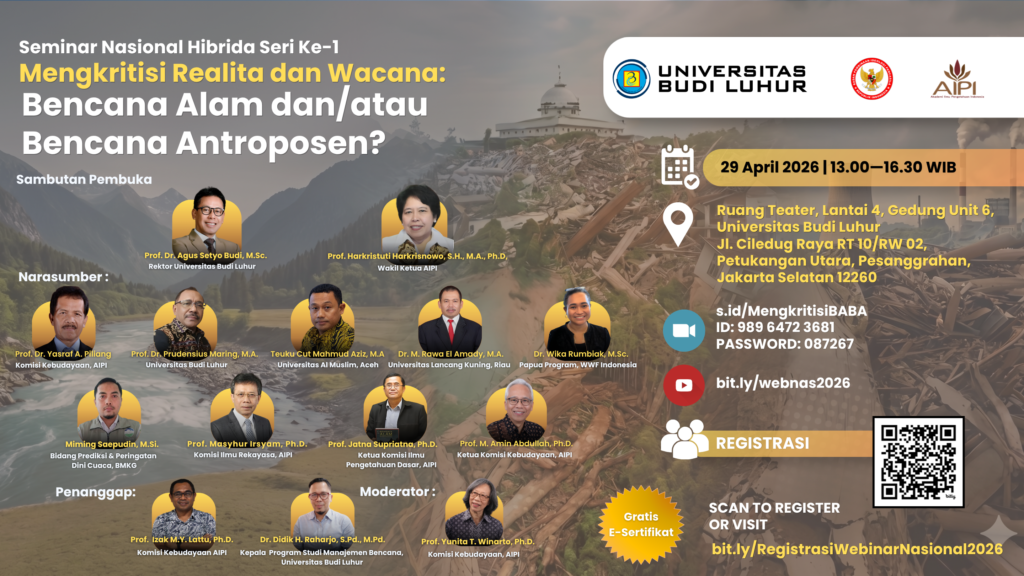
To address this strategic question, the Culture Commission of the Indonesian Academy of Sciences (AIPI), in collaboration with the Pancasila Ideology Development Agency (BPIP) and Budi Luhur University, will host a Hybrid National Seminar entitled: “Critiquing Reality and Discourse: Natural Disasters and/or Anthropocene Disasters?”
This seminar will take place on Wednesday, 29 April 2026, from 13:00 to 16:30 WIB, in the Theatre Room, 4th Floor, Building 6, Budi Luhur University, Jl. Ciledug Raya, Petukangan Utara, Pesanggrahan, South Jakarta 12260. This National Seminar will be held in a hybrid format (in-person and online) and can also be attended online via the Zoom app using the link https://s.id/MengkritisiBABA, with Meeting ID: 989 6472 5918 and Passcode: 087267. The event can also be followed via the YouTube app via the link at https://bit.ly/webnas2026.
This event marks the opening of AIPI’s 2026 series of strategic studies, centred on the overarching theme “Quo Vadis Anthropocene Disasters: Preventing the Destruction of the Indonesian Archipelago”. The seminar will not merely present scientific papers but will also adopt a critical interdisciplinary approach—combining discourse analysis, empirical disaster studies, and philosophical and ideological reflections grounded in the values of Pancasila. By involving leading academics, researchers, disaster management practitioners, and policymakers, this forum is expected to clarify the public’s misunderstanding, which has tended to oversimplify disasters as mere natural phenomena.
This seminar aims to: 1) clarify public understanding of the types and causes of disasters; 2) promote more appropriate and science-based policies; and 3) reinforce the collective awareness that disasters are not merely a matter of fate, but also the result of human choices.
This National Seminar is structured around the presentation of disaster case studies, reviews by speakers, responses and summaries by panellists, and dialogue with both in-person and online participants alongside the speakers. The seminar agenda is divided into four sessions. Session One – discusses the conceptual framework of the seminar’s theme on disasters, featuring the following speakers: 1) Prof. Dr. Yasraf A. Piliang – member of the AIPI Culture Commission – who will present “Critical Discourse Analysis using the 2025 Sumatra disaster and several other disasters outside the Sumatra region”; 2) Prof. Dr. Prudensius Maring, M.A. – Director of Research and Community Service, Budi Luhur University – who will present on disasters in NTT under the title “Tropical Cyclone Seroja in NTT: Interpreting Natural Disasters within the Anthropocene Landscape”; 3) Teuku Cut Mahmud Aziz, S.Fil., M.A. – lecturer at Al Muslim University, Bireuen, Aceh – will present a case study on disasters in Aceh and their development under the title “[ACEH NGOP] Aceh Disasters: Traces of the Anthropocene in Aceh”; 4) Dr Rawa El Amady, M.A. – lecturer at Lancang Kuning University, Pekanbaru, Riau – will report on disaster cases in the Riau region under the title “Disaster as a Construction of Power: A Political Ecology Perspective on the Anthropocene Crisis in Riau and the Riau Islands”; 5) Dr Wika A. Rumbiak, S.T., M.Sc. – Head of the Forest and Wildlife for Papua Programme, WWF Indonesia – will present the theme “Clarifying the Discourse on Disasters & the Anthropocene – An Empirical Study of Three Coastal Villages in Tambrauw”.
The second session of the seminar will focus on the discussion of empirical case studies of disasters in the three regions mentioned above, with the aim of gaining a deeper and more comprehensive understanding—not limited to the factors causing and triggering these disaster events, but also involving a clearer distinction between “natural disasters, anthropogenic disasters, or a combination of the two”. The speakers invited are: 1) Miming Saepudin, M.Si., who has extensive experience in the field of Public Meteorology at the BMKG, will discuss natural phenomena related to the consequences of climate change occurring in the equatorial region of Indonesia over the past decade, particularly towards the end of 2025, as well as the potential for similar disasters in the future; 2) Prof. Ir. Masyhur Irsyam, M.S.E., Ph.D. – a member of the Engineering Sciences Commission, AIPI – who will explain and identify the criteria for natural disasters and review the natural phenomena that act as conditions and triggers for disasters in the four regions discussed in the First Session; 3) Prof. Jatna Supriatna, Ph.D. – Chair of the Basic Sciences Commission, AIPI – will outline the interconnection between the two phenomena: natural disasters and Anthropocene disasters, as well as their implications for the livelihoods of humans, fauna and flora; 4) Prof. M. Amin Abdullah, Ph.D. – Chair of the Culture Commission, AIPI – will present a paper entitled “Anthropogenic Disasters in the Archipelago”, examining the primary factors causing the vulnerability of natural conditions to extreme events as a consequence of climate change, and their implications for human survival within their ecological niches.
Next, in the Third Session, an interactive dialogue session was held, moderated by Prof. Yunita T. Winarto, Ph.D. – a member of the AIPI Culture Commission – during which both online and in-person seminar participants were encouraged to participate actively and were given ample opportunity to respond to, discuss, and ask questions regarding the disaster-related topics presented by the speakers in the First or Second Sessions. The Fourth Session allocated time and space for “responses and summaries”, with the aim of synthesising the conceptual presentations, empirical realities, analytical studies, and key topics raised by the public. The speakers leading this Final Session are Prof. Izak Y.M. Lattu, Ph.D. – a member of the Culture Commission, AIPI; and Dr. Didik H. Raharjo, S.Pd., M.Pd., Head of the Disaster Management Programme, Budi Luhur University. The entire series of events for this National Seminar will be opened by the Rector of Budi Luhur University, Prof. Dr. Agus Setyo Budi, M.Sc., and the thematic address for the seminar will be delivered by the Vice-Chair of AIPI, Prof. Harkristuti Harkrisnowo, S.H., M.A., Ph.D.
From the series of discussions that took place during the seminar—which was open to the public, university staff, researchers, academics, students, disaster management policymakers, and other stakeholders —views will be gathered that can serve as the basis for producing policy recommendations in the form of policy briefs, for example, academic papers for scholarly books, or they may constitute a meaningful contribution to the “AIPI Perspective” for the Government.
Website : aipi.or.id
Instagram : aipi_Indonesia
Twitter : AIPI_id
YouTube : AIPI_Indonesia
Press Release Author:
Sigit Asmara Santa
Science Administration Bureau, AIPI.